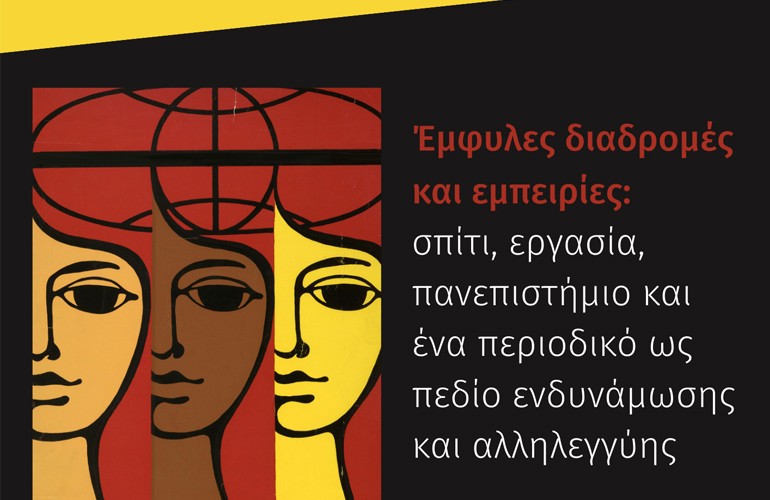
Gendered Paths and Experiences: Home, Work, University, and a Magazine as a Field of Empowerment and Solidarity

On the occasion of International Women’s Day, the Editorial Committee of the journal ‘EIRINI: Studies by Young Researchers on Gender,’ in collaboration with the ‘Culture-Borders-Gender’ Laboratory of the Department of Balkan, Slavic, and Oriental Studies, and the Committee on Gender Equality and Combating Discrimination of the University of Macedonia, is organizing an informative event titled ‘Gendered Paths and Experiences: Home, Work, University, and a Magazine as a Field of Empowerment and Solidarity‘ on Wednesday, March 8, 2023, from 1:30 to 3:30 PM in the ‘Ilias Kouskouvelis’ Conference Hall.

For those who are unable to attend in person, there is an option to connect here:
Link https://zoom.us/j/8364531775?pwd=OVg3YVZlbmVCYWs3S0JYcEFGYlV1QT09
Meeting ID: 836 453 1775 Passcode: KB2JKa

Language of the event: Greek

“Untiling” the tiles of today’s Balkan mosaic Filmmaking workshop on storytelling & film screenings

INVITATION FOR REGISTRATION

Organizing team: Balkans Beyond Borders & Culture –Borders –Gender/Lab, University of Macedonia, department of Balkan, Slavic & Oriental Studies.

Date: Friday, March 3d, Thessaloniki, Greece

15:00 – 19:00 workshop and film marathon

The workshop is funded by the Research Committee – UOM.

Description
What does cinema, intersectionality and Haiku poems have in common?

Drawing upon the theme of the 13th Balkans Beyond Borders Short Film Festival titled ‘Untiling the Mosaic’ we invite you to a workshop, where we will discuss and contemplate on the “gaze”, anthropology in film, how to tell stories through images, and address the multiple identities we all carry, our personal and social mosaic. We invite you to create your own short films, consisting of three acts through three shots, inspired by the structure of Haiku poems, which are made up of three verses which capture a moment in the present time, within the ‘now’, kind of like a movie.

The workshop and film marathon will be followed by a screening of selected films from the competition programme of the 13th Balkans Beyond Borders Short Film Festival ‘Untiling the Mosaic’, consisting of films by young filmmakers from the Balkans, which thematically touch upon the experience of the coexisting multiple and intersecting identities such as gender, social class, sexuality and ethnicity. By making this ‘mosaic’ visible and deconstructing it, the possibilities of redefining it, suddenly appears.

Programme

Workshop: “Haiku Shorts: filmmaking and storytelling in three acts”

15:00 – 15:30 “Cinema and Anthropology. Saying a lot just in few words”, Eleni Sideri , Ass. Prof. BSOS-UoM

15:30 – 16:00 “’Mosaic of identities & telling stories: film form in three acts’”, Vasiliki Maltasoglou, Festival Director & co-founder of Balkans Beyond Borders.

Film Marathon 17:00 – 19:00

We wander and explore the nearby environment, the neighborhood of the university, and film with our mobile phone or any other equipment at our disposal, images, sounds and sensations that capture a mosaic of identities that coexist in a moment in time. The Haiku poem, consisting of three verses, becomes the vehicle of the cinematic composition and creation of a film, with a maximum duration of 1 minute, consisting of three shots.

  • Delivery of films and experience sharing 19:00-19:30

 Number of Participants: 15 There will be accepted in order of priority. Certificates of attendance will be given.

Registration Form: https://forms.gle/K2xdowhDXY6C5fvw7

CV’s of participants

Vasiliki Maltasoglou is Festival Director of the Balkans Beyond Borders Short Film Festival and co-founder of the organization Balkans Beyond Borders. She has finished her studies in International Politics but professionally her expertise is in digital marketing. In Balkans Beyond Borders she directs the Festival, realizes workshops on filmmaking and storytelling, and curates all screenings and cultural events of BBB. 

Eleni Sideri

https://www.uom.gr/en/elasideri
Inter-Research Exercises in the ‘Refugee Neighborhood’ of Sykies

The Culture-Borders-Gender/Lab (UOM) and the Cultural Neighborhood of the Municipality of Neapolis-Sykies are launching their collaboration with ‘Research Exercises in the ‘Refugee Neighborhood’ of Sykies.’

On Friday, May 27, 2022, there will be a guided tour along the ‘refugee neighborhood’ route, followed by a presentation of research activities and planning of joint collaborations between the University and the Municipality of Neapolis-Sykies by the members of the Culture-Borders-Gender/Lab (UOM).

The meeting will take place on May 27, 2022, at 10:00 AM at the entrance of Eptapyrgio.

Interested participants are kindly requested to register using the form below by May 25, 2022: https://forms.gle/YDjg5nEusGqLKyLv7

Scientific Conference – Refugees as a tool of growth: Lessons from 1922 and prospects. 23-24/ 9/2022

On the occasion of the hundredth anniversary of 1922, 2022 will be dedicated to the ‘refugee phenomenon’. The gradual inclusion of refugees from Asia Minor, Pontus and other areas of population exchange was an important part of the economic development and modernisation of the society in Greece. Research has been conducted since the 1920s documenting the economic contribution of refugees to the development of the host country (Aigidis 1928). The keywords ‘development’, ‘refugees’ are conceptually and theoretically charged terms because of the multiple and conflicting views and interpretations often identified with the developmental policies which are sometimes applied to expatriate populations in specific areas like Africa and Middle East.

The conference will focus on the experience of 1922 precisely through the possibilities and perspectives that opened in the Greek society and economy for a dynamic transformation. What were the international and national policies and practices that supported this transformation? What were the reactions of the society and the refugees themselves? When, by whom and for how long are they considered ‘refugees’? What are the short-term, medium-term and long-term assessments of the ‘refugee factor’? At the same time, the experience of 1922 will be used comparatively to open a discussion with relevant experiences from the wider south-eastern Europe and the Mediterranean basin as well as the current policies and practices implemented or proposed and treat refugees positively as a potential research for development for the host country. What does the concept of ‘positive example’ (success) mean in the case of a ‘refugee crisis’ (economic, social and cultural integration)? How does it help us to understand and socially integrate new categories of refugees into modern reality.

The conference will take place at University of Macedonia -Thessaloniki in a hybrid way.

Proposed themes
-refugees and economic development
-inclusion policies
-inclusion and housing, urban and residential changes
-work and gender
-refugee capital and home countries
-inner migration and urbanisation
-refugees and cultural capital (case studies)
-comparative example, case studies
-international organisations, development aid and refugees
-education-language-host country
-museum, literary and artistic prints

Organisation: Department of Balkan, Slavic and Oriental Studies, Laboratory of Culture, Borders and Gender, Department of Economics, Laboratory of Economic and Social Research, Department of Music Science and Arts, MA in “History, Anthropology and Culture in Eastern and Southeastern Europe, MA in ” Human Rights and Migration Studies “

Scientific Committee: Eleni Gavra (Professor UoM), Eftihia Voutira (Professor Emerita UoM), Fotini Tsimbiridou (Professor UoM), Konstantinos Tsitselikis (Professor UoM), Eleftherios Tsοulfidis Professor UoM), Theodore Panagiotidis (Professor, UoΜ),Theodosios Karvounarakis (Professor UoM), Eleni Sideri (Assist. Professor UoM), Eleni Kallimopoulou (Assist. Professor UoM), Eleftherios Tsikouridis (Assist. Professor UoM), Alexandra Ioannidou (Professor UoM, Ioannis Manos (Ass. Professor UoM), Nikolaos Zaikos (Ass. Professor UoM), Stavroula Mavrogeni (Ass. Professor UoM), Nikolaos Liazos (Assist. Professor UoM)

Organising Committee: Eleni Gavra (Professor UoM), Eleni Sideri (Assist. Professor UoM), Anna Moumtzoglou (Special Tech. Staff, UoM), Styliani Letsiou (Adjunct Faculty, MA in Human Rights and Migration Studies, Postdoctoral Fellow UoM), Dorotheos Orfanidis (Postdoctoral Fellow UoM), Stefanos Katsoulis (PhD Candidate UoM)

Interested parties should send until 31/3/2022, a title, a summary (300 words), 5 keywords and 1-2 reference titles, as well as a short bio (5 lines) to refugeesanddevelopment2022@gmail.com.

Registration for the conference will be 50 euros.
For PhD. candidates will be 25 euros.
Attendance of the conference for the undergraduate and postgraduate students will be free of charge.

site: https://refugees-growth.gr/

Semiotics in the Lifeworld 15th World Congress of Semiotics / IASS-AIS August 30 – September 3, 2022, Thessaloniki, Greece

The 15th World Congress of Semiotics aims to foreground semiotics as the socially engaged, critical investigation of the sign – and meaning-making processes forming the core of human worldmaking. Semiotic investigation is grounded in the historical lifeworld, in concrete timescapes and semioscapes, in the dense and dynamic weave of semiotic practices that structure human experience and communicative (inter)action by constantly (re)articulating the perceptual and the conceptual, the discursive, and the performative, the ethical and the aesthetic, the ideological and the figurative, the material and the immaterial, the human and the non-human, the natural and the man-made.

Semiotics world

Important Dates
Call for panel proposals
June 1 – July 30, 2021
Call for paper abstracts
September 1, 2021 – March 31, 2022

Learn more about the Congress

Book Launch & Celebratory Εvent

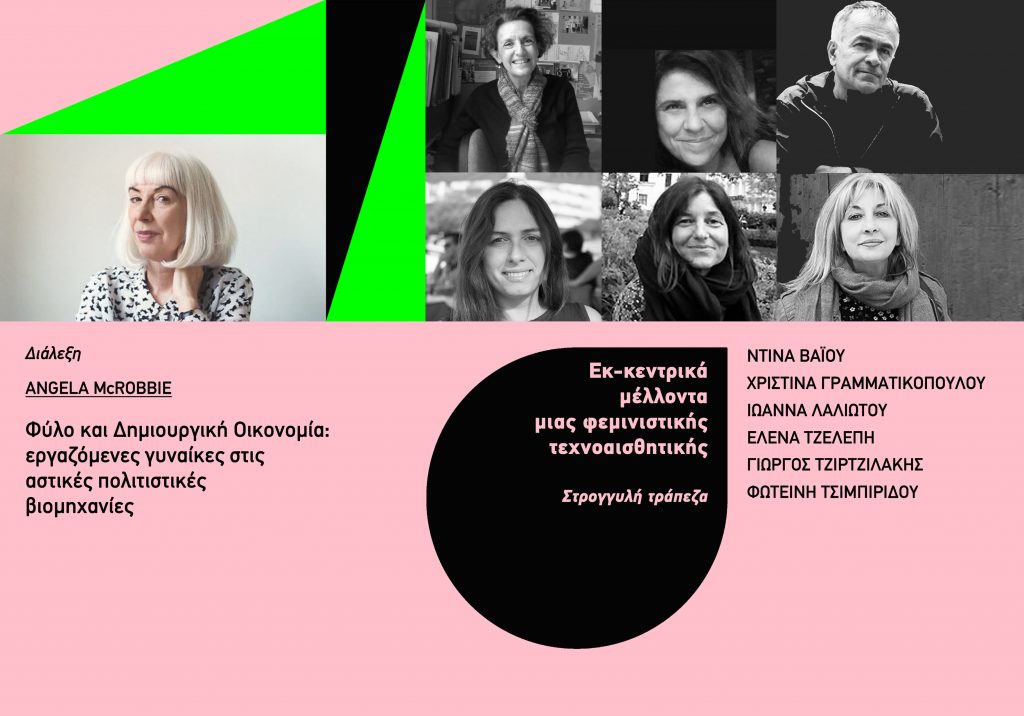
On Tuesday 29 June, 18:00 (GMT+3), we are inviting you to a celebratory event into 2 parts for the completion of the first circle of works of the Centre of New Media and Feminist Public Practices and the launching of the publication Feminist Theories, Aesthetic Practices and Globalised Technologies and the situated and international perspectives of its new season.

PART Α:
Keynote Lecture by Angela McRobbie (Emeritus Professor of Communications, Goldsmiths College), ‘Gender and the Creative Economy: Women Workers in the Urban Cultural Industries’.

PART B:
A round table discussion will follow the keynote lecture, titled ‘Ec-centric futures of feminist techno-aesthetics’ with affiliated collaborators
-Christina Grammatikopoulou (curator, Digital Culture, University of Macedonia, University of Western Macedonia),
-Ioanna Laliotou (Historian, Vice Rector of International and Public Relations, University of Thessaly),
-Fotini Tsibiridou (Social Anthropologist, University of Macedonia, Director of Culture-Borders-Gender/Lab)
-Elena Tzelepis (philosopher, University of Thessaly)
-Yorgos Tzirtzilakis (architect, University of Thessaly, artistic advisor of DESTE Foundation for Contemporary Art)
-Dina Vaiou (Architect-Urbanist, Emeritus Professor National Technical University of Athens).

The event will be held on ZOOM and simultaneous interpretation would be available (greek-english).Meeting ID: 851 4344 7097
Passcode: 333507
https://us02web.zoom.us/u/khXhYqpOB

In case the ZOOM meeting is full, live streaming will also be available via our Facebook page
https://www.facebook.com/centrefeministmedia