ETHNOGRAFEIN
Critical dialogues, epistemological challenges, field experiences, creative texts
Ethnographic encounters with value, infrastructures, and collective life.
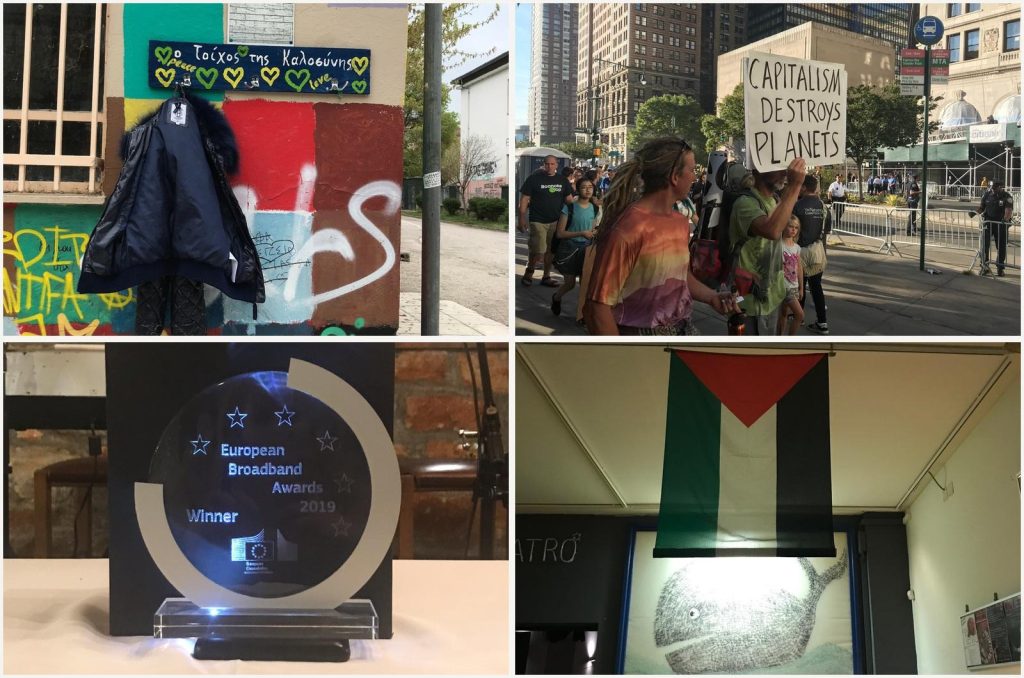
Photographs: Aimilia Voulvouli – Karditsa, New York, Pythio, Naples
The webinars are held on Mondays, 16:00–18:00 (Athens time)
Online seminar platform:
https://zoom.us/j/8364531775?pwd=OVg3YVZlbmVCYWs3S0JYcEFGYlV1QT09
Meeting ID: 836 453 1775
Passcode: KB2JKa
Since its launch in the spring of 2021, the online seminar series ETHNOGRAFEIN has sought to contribute to a critical and interdisciplinary discussion on the theory and practice of ethnography, the epistemology of research, the significance of embodied experience, as well as the ways in which anthropological knowledge is disseminated to both academic and non-academic audiences. It is a central aim that anthropological study – as a research practice and as a politics of writing – should incorporate critical evaluation, empathy, reflexivity, and self-referentiality, while highlighting the importance of multimodal analysis of the local for understanding the general.
Organized by: Culture – Borders – Gender Laboratory (CBG/LAB), University of Macedonia
Coordination of the 7th series: Aimilia Voulvouli
Annual theme
Ethnographies of the Economy: Value, Labour, Infrastructures and Commons
How is value produced, accumulated, and transformed in a world marked by successive crises?
How are economic processes intertwined with infrastructures, labour relations, social reproduction, and people’s capacities to shape their futures?
The seventh edition of the ETHNOGRAFEIN Online Seminar Series, entitled “Ethnographies of the Economy: Value, Labour, Infrastructures and Commons,” explores the social relations, political contradictions, and everyday practices through which economic life is constituted. Drawing on ethnographic research across diverse geographical and political contexts, this year’s lectures examine changing forms of capitalist accumulation and dispossession, crises of social reproduction, energy infrastructures and the geopolitical relations surrounding them, as well as transformations of property, labour, and economic participation. From critical examinations of the destruction of human and non-human life as a condition of capitalist accumulation to floating energy infrastructures connecting Turkey and Ghana, and from transnational property investments linking Israel/Palestine and Greece to the labour trajectories of refugee women in Norway and Jordan, the lectures illuminate how economic processes are embedded in relations of kinship, care, property, and political power.
Particular attention is paid to how people seek to secure their livelihoods, navigate uncertainty, and create possibilities for the future under conditions of uneven development, displacement, austerity, and environmental destruction. By bringing different ethnographic perspectives into conversation, this year’s seminar series seeks to approach the economy not as an autonomous sphere, but as a field of social relations, moral claims, political struggles, and ongoing transformations.
PROGRAMME AND ABSTRACTS
23 November 2026
Susana Narotzky – University of Barcelona
Ethnographies of capitalism: crises, value, and the extraction of life
Abstract: Often described as “crises” reproductive breakdowns have been analyzed as conjunctural and structural challenges to social reproduction. In the present, the reckless despoliation of life – of humans and nature – seems to expand without limits everywhere. It appears that dispossession and disposability have become key to the accumulation of capital as systemic reproduction rests on the decaying environments, bodies, and lives of the many, making their social reproduction increasingly difficult and apparently meaningless to capital. Here we ask if this situation is sustainable in terms of systemic reproduction or if it will eventually result in “negative value” endangering the system.
14 December 2026
Frederick Wojnarowski – American University in Cairo
“They Are Bleeding Us”: following water through infrastructure, value, scarcity and protest in Jordan
Abstract: This talk develops the central argument of my book project through an ethnographic journey that follows water across the infrastructures and moral worlds it links. It takes the titular claim – made by a farmer-activist in the poor, marginalised rural district of Dhiban in central Jordan – as an entry point into the social life of water under conditions of anticipated and discursively produced scarcity and uneven experiences of socio-ecological breakdown. Beginning in Dhiban, I show how “scarcity” is encountered less as a national hydrological fact than as lived politics of uneven distribution, infrastructural breakdown, contamination and wastewater controversies, shaped by changing state hydraulic missions and international flows of finance and expertise. I then follow the water outward through the hydro-social metabolism that links rural wells, dams, pipelines, tanker markets, and urban supply, revealing how different communities are differentially protected, disciplined, or sacrificed by the same system.
I argue that these contested flows are also regimes of value in motion, tied to the shifting ways water is made meaningful and governable: as commons and moral obligation, as a right and distributive claim, as a priced service, and as a quasi-commodity shaped by abstraction and financialization. These regimes coexist and collide, and their collisions generate a distinctive form of agrarian environmental politics. In Dhiban, activists repoliticize water through idioms of corruption and distributional justice, reframing scarcity as a question of sovereignty, harm, and, crucially, who is made to bear the future of scarcity and contamination. In a moment when the technopolitics of international environmental “fixes” is unravelling and under attack from multiple directions, such a perspective might prove a salutary unsettling of our environmental narratives.
15 February 2027
Gökçe Günel – Rice University
Floating Power: Energy, Infrastructure, and South-South Relations
Abstract: This talk traces the emergence of Ayşegül Sultan, a floating power plant in Ghana’s Tema fishing harbor, owned and operated by the Turkish family business Karpower. Using this ship-cum-generator as a lens, I advance a broader argument about global energy politics, critiquing the dominant, unilinear narrative of “energy transition,” which posits the possibility of substituting fossil fuels with other energy sources. Instead, ethnographic research in Turkey and Ghana reveals a landscape of accumulation, where various types of infrastructure-hydroelectric, heavy fuel oil, natural gas, and solar-layer upon one another. This all-of-the-above approach relies upon and reproduces what I call “technologies of deferral,” such as the floating power plant at the center of the talk, which are perceived as temporary stopgaps but often become semi-permanent fixtures. Overall, the talk highlights the thick geopolitical and geoeconomic connections between Turkey and African countries, demonstrating how South-South relations are reshaping global energy networks and vice versa.
8 March 2027
Andrea Wright – William & Mary
Dislocated Politics: Debt, Contracting, and Solidarity Among Indian Migrant Laborers
Abstract: In order to migrate to the Gulf, Indian workers take on large debts at high interest rates. After they migrate, workers find that in the Gulf they are excluded from public spaces, unions are banned, and strikes are illegal. Because of these strict restrictions on strikes and unionizing, Gulf cities are often viewed as depoliticized spaces. In addition, jobsites are filled with contractors and subcontractors, making it hard for workers to collectively organize. The workers who have the most challenging employment experiences are often employed as contract laborers at such projects. It is not uncommon for workers with negative employment experiences in the Gulf to return to their homes in greater debt. In some cases, this has led men to commit suicide. Other men are killed while working on jobsites, leaving their families destitute.
In response to situations such as these, a group of men who live near Hyderabad, India, and who had previously worked in the Gulf have formed a migrant advocacy association. This association uses digital media to build and sustain solidarity among returned and current migrants and to exert pressure on local Indian government officials. Their hope is that government officials will intervene and improve conditions for Indian workers in the Gulf. The group often mobilizes after a worker suicide or death on a jobsite. Through an ethnographic analysis of this group’s activities and the experiences of migrants in the Gulf, this paper will demonstrate that there is political action around migrant work in the Gulf. However, this political action is dislocated spatially, insofar as it occurs in South Asia as opposed to in the Gulf, and temporally, insofar as it occurs after crises have occurred. Rooted in debt and mediated through digital media, this dislocated politics emerges in response to contracting and contract labor, both of which displace risk onto the most precarious workers and are increasingly the norm in global capitalism.
22 March 2027
Canay Özden-Schilling – National University of Singapore
“Logistics Culture:” Making Sense of Supply Chain Capitalism Culturally
Abstract: This talk is set in Mersin, Turkey – a city on the Eastern Mediterranean, home to a privatized, Singaporean-administered port. Mersin is a historical confluence for small-scale logistics providers, who connect hinterland industrialists to the port, while absorbing the occasional shocks to trade on their clients’ behalf. In that, they draw on a diverse repertoire of resources, from family connections to language skills to equipment access, all of which the locals broadly refer to as the city’s “logistics culture.” In this talk, I explore this emic concept ethnographically and ask what it can reveal about contemporary maritime shipping, whose extreme scaling in recent years has come to undergird supply chain capitalism. I argue that Mersin’s logistics providers’ small size, transient nature, and lack of collective voice allow the port, the regional custodian of shipping, to receive an outsized and growing share of the city’s overall revenue from maritime shipping. I suggest that, for anthropologists, there is a renewed opportunity in this interpretation of culture to better grasp how the small make way for the big in contemporary capitalism.
12 April 2027
Sophia Stamatopoulou-Robbins – Bard College
Siege Creep: De/tachments across Israel/Palestine and Greece
Abstract: This talk draws on long term fieldwork for two book projects, one based in Palestine and the other based in Greece, to ask how destructive conditions – be they genocide or austerity remake relations, attachments, and disconnections. It begins in the waste siege that inundates Palestinians in the occupied West Bank to show how waste and the infrastructures that Palestinians attempt to build to manage them are braided into people’s senses of ethics and visions of collective futures. It then crosses the Mediterranean, following Jewish and Palestinian citizens of Israel whose lives are also, if unevenly, shaped by waste siege. In growing numbers, they are moving money out of Israel/Palestine to invest in Athenian apartments that run as Airbnbs. I consider what I call the “speculative attachments” that bind these investors to Athenian apartments as they seek alternative pathways to building wealth for kin. At the same time I consider Athenian families’ experiences of turning properties that were once stored family assets into Airbnbs, enacting what I call “partial detachments” under a siege of prolonged austerity. Thinking Palestine’s waste siege and Greek austerity together brings into view how sieges creep across oceans and intermingle across political boundaries. Tracking inundation by waste in one place and the reorganization of relations to, and through, property in another also illuminates the related forms of relationality afforded when people harness infrastructures to make life workable under conditions of duress.
10 May 2027
Sarah A. Tobin – Chr. Michelsen Institute
From Integration to Entrepreneurship: The Moral Economies of Female Immigrant Labour in Norway and Jordan
Abstract: Drawing on ethnographic research with Syrian refugee women in Norway and Jordan, this talk explores how very different labour market regimes produce unexpectedly similar outcomes. In Norway, integration policies encourage women into extensive programmes of language training, education, and work placement; in Jordan, refugee employment is shaped by gendered assumptions about who “needs” work and which forms of labour are appropriate for women. Across both contexts, many women encounter structural barriers that steer them toward self-employment and entrepreneurship. The talk examines how ideas of value, care, deservingness, and economic participation shape women’s working lives and asks what refugee entrepreneurship reveals about the moral economies underpinning contemporary migration governance.
SHORT CVs OF PARTICIPANTS
Susana Narotzky is Professor of Social Anthropology at the University of Barcelona. Her research focuses on political economy, labour, social reproduction, economic inequalities, and everyday experiences of capitalist crisis. Drawing on ethnographic research, primarily in Southern Europe, she explores the relationships between economic transformations, moral understandings, and collective action. Her work has made significant contributions to anthropological debates on value, class, and precarity. She is the author of New Directions in Economic Anthropology (1997) and, with Gavin Smith, Immediate Struggles: People, Power, and Place in Rural Spain (2006). In 2020, she received Spain’s National Research Award in the Humanities, and since January 2026, she has served as a member of the Scientific Council of the European Research Council (ERC).
Fred Wojnarowski is Assistant Professor at the American University in Cairo. His research focuses primarily on Jordan and the wider Mashriq, exploring the intersections of natural resources, infrastructure, political economy, and social mobilization. Combining ethnography, archival research, and discourse analysis, he examines changing regimes of value and struggles over justice, authority, and the common good. His current book project, Bled Dry, investigates water scarcity, moral economy, and environmental politics in Jordan. He is also developing comparative research on water justice and the commons in the United Kingdom. His forthcoming book, History and Protest in Jordan’s Bedouin Villages, examines rural and tribal protest movements. He received his PhD in Social Anthropology from the University of Cambridge in 2021 and previously held a British Academy Postdoctoral Fellowship at the London School of Economics.
Gökçe Günel is Associate Professor in Anthropology at Rice University. Her research investigates how infrastructure transforms amid energy- and climate-change-related challenges. She is the author of Spaceship in the Desert: Energy, Climate Change, and Urban Design in Abu Dhabi (Duke UP, 2019) and Floating Power: Energy, Infrastructure, and South-South Relations (Duke UP, 2026). She co-leads Patchwork Ethnography and is the co-author of Patchwork Ethnography: A Methodological Guide (Chicago, 2027).
Αndrea Wright is the Class of 1952 Associate Professor of Anthropology and Asian & Middle Eastern Studies at William & Mary, where she has taught since 2016. Her research explores the histories of capitalism and its contemporary expression, and her focus is on the ways labor movements and energy production shape governance, economies, and geopolitics in South Asia, the Arabian Peninsula, and globally. She is the author of Between Dreams and Ghosts: Indian Migration and Middle Eastern Oil (Stanford University Press, 2021) and Unruly Labor: A History of Oil in the Arabian Sea (Stanford University Press, 2024).
Canay Özden-Schilling is an anthropologist of capitalism, technology, and infrastructure, with past and ongoing research projects on markets of electricity and global port logistics. Broadly, she is interested in the scientific and technological work cultures that create and disseminate the economic formations with which we live. Her first book, The Current Economy: Electricity Markets and Techno-Economics (Stanford University Press, 2021), is an ethnography of the electric grid in the United States in the age of competitive markets and smart grids. Her current book-length project explores maritime shipping, as seen from the port cities of Mersin (Turkey) and Singapore.
Sophia Stamatopoulou-Robbins is Professor of Anthropology at Bard College. Her research focuses on infrastructure, environment, waste, platform capitalism, and the home, exploring how destructive processes such as military occupation, environmental degradation, and austerity reshape social relations and possibilities for the future. Her award-winning book, Waste Siege: The Life of Infrastructure in Palestine (Stanford University Press, 2019), examines the political and social dimensions of waste in Palestine. Her forthcoming book, Controlled Alienation: Airbnb and the Future of Home (Duke University Press), explores how austerity and platform-mediated home-sharing jointly transform domestic life in Greece. She serves on the editorial board of Cultural Anthropology and the advisory board of Critical AI. She received her PhD in Anthropology from Columbia University in 2015.
Sarah A. Tobin is Research Professor at the Chr. Michelsen Institute (CMI) in Bergen, Norway. Her research examines governance, migration, displacement, religion, and political economy in the contemporary Middle East, with a focus on everyday experiences of authority, citizenship, and social change. She is the author of Everyday Piety: Islam and Economy in Jordan and founder of Na’rif, a network supporting research on Islamic finance in Europe.