Ethnografein
Critical dialogues, epistemological challenges, field experiences, creative texts

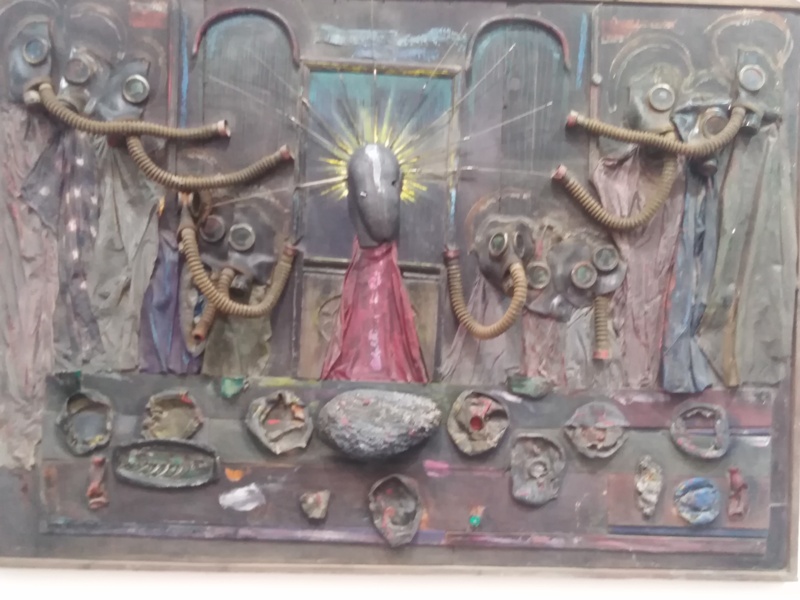
| ΒΑΤUMI, ALPHABET TOWER, 2023 | OTAR CHKHARTISHVILI, THE LAST SUPPER, 1983, Georgian Museum of Fine Art, Tiflida |
Photos: selection E. Sideri
The webinars are held on Mondays from 16:00-18:00
————————————————————————–
Seminar Platform: ZOOM
https://zoom.us/j/8364531775?pwd=OVg3YVZlbmVCYWs3S0JYcEFGYlV1QT09
Meeting ID: 836 453 1775
Passcode: KB2JKa
Since its launch in the spring of 2021, the online seminar series ETHNOGRAFEIN has sought to contribute to a critical and interdisciplinary discussion on the theory and practice of ethnography, the epistemology of research, the significance of embodied experience, as well as the ways in which anthropological knowledge is disseminated to both academic and non-academic audiences. It is a central aim that anthropological study—as a research practice and as a politics of writing—should incorporate critical evaluation, empathy, reflexivity, and self-referentiality, while highlighting the importance of multimodal analysis of the local for understanding the general.
Organization and Coordination: Fotini Tsibiridou – Ioannis Manos – Eleni Sideri
Organization and Coordination of the 6th Cycle: Eleni Sideri
The 6th cycle of the ETHNOGRAFEIN online seminar series, beginning in December 2025 and concluding in May 2026, is entitled:
Annual Theme
Ethnographies of Eurasia: Centres, Peripheries, Power and Critical Area Studies
Eurasia has long occupied an ambiguous position in international academic research: a space where continents, empires, and epistemologies intersect, but also a region often portrayed as peripheral in relation to the dominant theoretical currents of the social sciences. The lecture series Ethnographies of Eurasia: Centres, Peripheries, Power and Critical Area Studies seeks to reconsider the region through the lens of contemporary ethnographic research, bringing into dialogue scholars who engage critically with questions of knowledge production, everyday life, and shifting geopolitical landscapes.
What is at stake is not only the representation of Eurasian societies, but also the analytical frameworks through which they are understood. The institutionalization of “area studies” during the Cold War placed Eurasia within particular disciplinary and geopolitical boundaries, often privileging state-centered narratives and strategic concerns over lived experience. Today, amid the revival of imperial discourses, new geopolitical alliances, and expanding transnational networks, the need for more nuanced and locally grounded approaches is pressing. Ethnography—attentive to voices, practices, and materialities—offers a methodological path for deconstructing hegemonically formed categories, while simultaneously foregrounding the actions and voices of communities in both the centres and the peripheries of Eurasia.
The series will highlight research from a wide range of cultural, social, and economic landscapes: from the margins of post-Soviet cities and the environmental crises of Central Asia, to ethnoscapes shaped by increasingly authoritarian regimes of mobility and emergent digital publics. The research presented will explore how power is exercised and contested in spaces where state authority, religious traditions, global markets, and social imaginaries intersect. Particular attention will be paid to the politics of scale: the ways in which “centres” and “peripheries” are relationally constituted, and how ethnographers themselves are implicated in the dynamics of representation and authority.
Beyond in-depth case studies, the lectures will address broader methodological and epistemological questions. How can we reconcile ethnographic particularity with the comparative ambitions involved in the study of different areas? What does it mean to produce knowledge about Eurasia at a moment when disciplinary boundaries are becoming increasingly porous and global hierarchies of scholarship are being reshaped? How might collaborative, decolonial, and multi-sited approaches challenge Eurocentric paradigms, while at the same time acknowledging the uneven flows of resources, languages, and institutional power that shape the field?
The series seeks to cultivate connections among researchers with diverse interests and fields of study, and across different anthropological approaches, interdisciplinary thinking, and the varied geographies that constitute Eurasia. In doing so, it aspires not only to enrich the understanding of the region but also to contribute to wider debates about the politics of knowledge, the future of ethnography, and the possibilities for a more plural and locally grounded social science.
Program
1st Panel 8/12/2025 16:00 – 18:00: “Globalising pro-russian chauvinism: modalities of Russianness in the Greek case”
D. Kataiftsis., Post-Doc Fellow, University of Macedonia
“The Russification of Mariupol after 2022 through the lens of housing and urban Planning Policies”
Guénola Inizan, Postdoctoral researcher, PhD in Geography – Lyon 2 Lumière University
2nd Panel 12/1/2026 16:00 – 18:00: “Azerbaijan’s Left and Emotions Across Borders: Problematzing Self-Reflexive Knowledge Production Amid Detachment, Digitality and Repression”
Veronika Pfeilschifter, Ph.D Candidate, Friedrich Schiller University of Jena
3rd Panel 16/2/2026 16:00 – 18:00: “Dismantled Materiality, Social Shifts, and Nostalgia: How to Make an Ethnography of the Soviet Legacy (the Case of Armenia)”
Yulia Antonyan, Associate Professor, Υerevan State University
Book presentation of Dr. Weronika Zmiejewski, “Georgian Women on the Move: Migration to Greece in Times of Crisis” , 2025, Beghahn
Weronika Zmiejewski, social anthropologist
4th Panel 2/3/2026 16:00 – 18:00: “Ethnographies of Landscape and Care: Gendered Ecologies and Urban Domesticities in Post-Socialist Romania”
Iulia Statica, Lecturer, Mellon Fellow, University of Sheffield, Harvard Institute in Washington, DC
5th Panel 30/3/2026 16:00 – 18:00: “Between a Knife and the Law: Human Rights and Expertise in Migration Bureaucracy in Tajikistan and Russia”.
Malika Bahovadinova, Research Associate, Univ. of Amsterdam
6th Panel 30/3/2026 16:00 – 18:00: “Trembling Light: The World Bank’s PESAC Programme and the Afterlives of Neoliberal Restructuring in a Kyrgyz Industrial Town”
Nikolaos Olma, Assist. Professor, University of the Aegean.
Spatharidou Dimitra, PhD, Dep. of Balkan Slavic and Oriental Studies, University of Macedonia: Support to the coordination of this panel.
7th Panel 27/4/2026 16:00 – 18:00: “Soundscapes and Memories of Exile: The Radio Programs of the Refugees of the Greek Civil War”
Aliki Angelidou, Associate Professor, Panteion University
Alexandra Balandina, Associate Professor, Ionian University
Dr. Maria Kokkinou, Post-doc researcher, Univ. of Gallaway
Dr. Georgia Sarikoudi, Post-doc researcher, Aristotle University of Thessaloniki
Vasiloglou Georgios, PhD, Dep. of Balkan Slavic and Oriental Studies, University of Macedonia: Support to the coordination of this panel.
8th Panel 4/5/2026 16:00 – 18:00: “The Making of an International Struggle: Mário Pinto de Andrade, Eurasian Connections and Angolan Liberation”
Elisa Scaraggi, Marie Skłodowska-Curie fellow at the Institute of Contemporary History at NOVA School of Social Sciences and Humanities in Lisbon
“India, Africa and the Politics of Southern Solidarity: How the Third World became the Global South”
Meera Venkatachalam, anthropologist and historian
Short CVs
Dimitris Kataiftsis is a Dr. in Cultural Studies (University of Paris-IV Sorbonne 2014) and external collaborator, teaching anthropology courses at the Department of Balkan, Slavic and Oriental Studies of the University of Macedonia. Since 2010, he has been conducting field research in communities of returnees from the former USSR, in Greece and abroad, mostly focusing on gender and economic reproduction. During his last postdoctoral research, he studied transnational networking, ethnic and cultural economies in the context of the Russian-speaking world and return migration, publishing articles in international journals and volumes and participating in international conferences. Finally, he actively participates in the scientific and editorial team of the journal EIRINI/Studies of Young Scholars on Gender, and in numerous activities of the Laboratory/Culture-Border-Gender (cbg-lab.uom.gr), at the University of Macedonia, as a regular member.
Guénola Inizan holds a PhD in Geography from Lyon 2 Lumière University (2024). Her dissertation examined the politicization of housing issues in the context of a major urban renewal project in Moscow. Since defending her thesis and following research fellowships at the Leibniz Institute für Länderkunde and the Faculty of Geography at the University of Łódź, as well as an upcoming residency at the Lviv Center for Urban History, she has been working on urban and housing policies in Russian-occupied territories in Ukraine.
Veronika Pfeilschifter is a social scientist working at the intersection between area studies (focus: South Caucasus) and political sociology. She is a research associate at the Institute for Caucasus Studies at Friedrich Schiller University Jena (Germany) and a research affiliate at the Centre for East European and international Studies (ZOiS) Berlin. Her doctoral project „In Quest for Otherwise: Left-Wing Subjects and Political Imagination in the South Caucasus“ analysed what it means for young subjects in Armenia, Azerbaijan and Georgia to be left-wing. Her work has been published in Constellations. An International Journal for Critical and Democratic Theory, Europe-Asia Studies and Caucasus Analytical Digest.
Yulia Antonyan is Associate Professor at the Department of Cultural Studies, Faculty of History, Yerevan State University (since 2008). Her professional interests are in the anthropology of religion and the anthropology of social structures, with a special focus on the Soviet and post-Soviet periods. Her permanent field of research is Armenia, but she has also undertaken several short-term field studies of Armenian communities in Georgia, Syria and Lebanon. Dr. Antonyan has published more than fifty articles in English, Armenian and Russian and has edited several volumes.
Weronika Zmiejewski is a social anthropologist specializing in the Caucasus and Central Asia. She earned her PhD from Friedrich Schiller University in Jena with a dissertation on Georgian migrant women in Greece, based on ethnographic fieldwork conducted in Greece (Thessaloniki) in 2015 and Georgia in 2016. She is currently working on a postdoctoral project focused on World War II recordings from Central Asia at the Phonogrammarchive in Vienna.
Iulia Statica is Mellon Fellow in Democracy and Landscape at Dumbarton Oaks, and assistant professor (lecturer) at the School of Architecture and Landscape at the University of Sheffield, UK. She previously held postdoctoral positions at The Bartlett School of Architecture, UCL, and Cornell University. Her research focuses on the legacies of socialist-built environments in Eastern Europe, particularly mass housing, and the gendered experiences of these spaces. Statica uses documentary film in her research; her film My Socialist Home premiered in London in 2021. She is the author of Urban Phantasmagorias: Domesticity, Production, and the Politics of Modernity in Communist Bucharest.
Malika Bahovadinova is a political anthropologist working on state-society relations. In her work, she explores the everyday politics of migration governance, looking at how bureaucratic ordering emerges as a site of unequal postcolonial and geopolitical relations. She also studies the citizens’ engagement with state controls and their agency in asserting a political role in authoritarian contexts. She works at the International Studies Program at Leiden University.
Nikolaos Olma is an Assistant Professor of Social Anthropology in the Department of Social Anthropology and History at the University of the Aegean and a participating researcher in the ERC-funded project “Anthropogenic Environments in the Future Tense: Loss, Change, and Hope in Post-Soviet Industrial Landscapes (ANTHEFT)” at the University of Vienna. He earned his PhD from the University of Copenhagen in 2018, with a dissertation that examined the nexus of embodied memory and urban infrastructure in Tashkent, Uzbekistan. Currently, he is working on a book project that explores the various processes of (un)knowing that inform life with radioactive uranium tailings in Mailuu-Suu, a former uranium mining town in Kyrgyzstan. His research interests span economic and environmental anthropology, with a focus on socio-economic change, post-socialism, extractivism, the politics of (un)knowing, pollution and toxicity, infrastructure, and informal mobility.
Aliki Angelidou is Associate Professor at the Department of Social Anthropology at Panteion University, Athens. Her research concerns both the anthropological readings of globalcapitalism in Greece and the Balkans, and the sensory dimensions of the experience of exile through the study of the Greek speaking radio broadcasts from the ex-socialist block. She is one of the two PIs of the research project “Soundscapes and Memories of Exile: The Radio Broadcasts of the Refugees of the Greek Civil War”.
Alexandra Balandina is an Associate Professor in Ethnomusicology at the Department of Music Studies, Ionian University. Her research areas include performance practice and theory, music creativity, cultural organology, ethnography, embodiment in performance and research, auditory cultures, music censorship, and music and politics. Music genres that she has researched, written and taught about include classical music of the Middle East and Central Asia, and popular music in Greece and the Balkans. Her latest book Ethnographic Research in Ethnomusicology, is open access and can be downloaded here https://repository.kallipos.gr/handle/11419/13733
Dr. Maria Kokkinou is a postdoctoral researcher on the BILQIS ERC project at the Irish Centre for Human Rights, University of Galway. She studied social anthropology at the University of the Aegean (Mytilene, Greece), then completed her master’s degree and PhD thesis in social anthropology in Paris at the École des Hautes Études en Sciences Sociales (EHESS).
Dr. Georgia Sarikoudi is a post-doctoral researcher at the Department of History-Archaeology at Aristotle University of Thessaloniki. She is currently teaching Greek language and history in secondary education. Her research interests include anthropology of socialism and post-socialism, social memory, economic anthropology and material culture, immigration and refugees’ studies, anthropology of education.
Elisa Scaraggi is a Marie Skłodowska-Curie Fellow at the Institute of Contemporary History, NOVA School of Social Sciences and Humanities in Lisbon. She has a background in comparative studies, and her work addresses questions related to the entanglement of personal and collective experiences in personal archives, as well as in autobiographies, memoirs, and other life-writing. She is interested in how colonialism and coloniality shaped the political, social, and cultural context of nations that emerged from the dissolution of the Portuguese empire, with emphasis on Angola and Brazil. Her current research focuses on the personal archive of Angolan nationalist Mário Pinto de Andrade as a key to uncovering new narratives about Angola’s recent past and the relationship between culture and nationalism.
Meera Venkatachalam is an anthropologist and historian. Her work is focused on the circulation of ideas, capital, and people between Africa and South Asia. She is the co-author of ‘Common Threads: Fabrics Made in India for Africa’ (ASCL: 2020); and co-editor of India’s Development Diplomacy and Soft Power in Africa’ (Boydell & Brewer: 2021).