 admin
admin
Culture-Borders-Gender /LAB: co-organizing the conference
The International Conference Cultural Neighborhoods and Co-productions In South-East Europe and Beyond 4th Conference on Contemporary Greek Film Cultures will be held digitally on the Zoom platform between 27-28 / 8/2020. The conference is organized by the Department of Balkan, Slavic and Oriental Studies and the Thessaloniki Film Festival as well as the Study Group of Contemporary Greek Film Cultures.
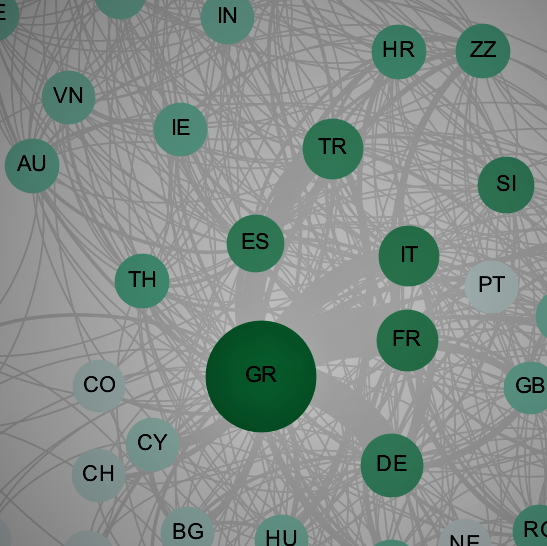
Through the different aspects of co-productions, the conference will explore how Greek cinema is connected to other regional cinemas, such as those of Southeastern Europe, and how these connections form ‘cultural neighborhoods’. In addition, it will explore how these links relate to the EU cultural policies as well as the formation of a European identity.
For the digital attendance of the conference there will be an announcement on the website https://contemporarygreekfilmcultures4.blogspot.com/ after 20/8.
The detailed programme is found at
https://www.dropbox.com/s/e6yx49daq6q1gjh/PROGRAM_1672020eng.docx?dl=0
For the Organizing Committee
Eleni Sideri
Assistant Professor
Calls for individual grant applications
ENTAN is pleased to announce two calls for individual grant applications which aim to encourage research on non-territorial autonomy (NTA) and minority related issues:
– Call for Short Term Scientific Missions (STSM) for scholars who wish to do research at a hosting institution abroad;
– Call for ITC conference grants available to researchers from inclusiveness target countries (ITC) who wish to present papers at conferences abroad.Application deadline is 30 August 2020.For updates, please check our website, and follow the work of ENTAN giving your likes on Facebook, Twitter and Instagram.
– Call for ITC conference grants available to researchers from inclusiveness target countries (ITC) who wish to present papers at conferences abroad.
Application deadline is 30 August 2020.
For updates, please check our website, and follow the work of ENTAN giving your likes on Facebook, Twitter and Instagram.
ENTAN – First Training School on Non-Territorial Autonomy
ENTAN is
organising the First Training School on Non-Territorial Autonomy, 9-11
September 2020, in the border region of Sønderborg, Denmark and
Flensburg, Germany.
Graduate and PhD students,
postdoctoral researchers and young career investigators (including those
who are ENTAN members) are invited to apply. Please share this Call for trainees with your PhD students and younger colleagues.
Application deadline: 15 June 2020.
We
are also inviting a limited number of experienced scholars who can
apply as lecturers on NTA topics, by 15 June 2020. Please find the
details in the Call for lecturers.
For updates, please check our website, and follow the work of ENTAN giving your likes on Facebook, Twitter and Instagram.
Distribute2020_Greek edition
The Society for Cultural Anthropology and the Society for Visual Anthropology are excited to bring to you its second carbon-neutral biennial conference: Distribute 2020, which will take place on May 7, 8, and 9, 2020.
Like its previous iteration (Displacements 2018), Distribute 2020 will be virtual and distributed: virtual in that it will be anchored by a dedicated conference website streaming prerecorded multimedia panels; and distributed in that presenters and viewers from across the globe will participate in the conference via in-person local “nodes.”
Distribute 2020 plans to offer three full days of streamed audio-visual panels and in-person local nodes where participants can gather with others to view the conference and join in related activities like workshops, art exhibitions, and dinner salons. Our goal is a low-cost, highly accessible, carbon-neutral conference that might pave the way for rethinking the mega-conference model.
Our 2020 theme, “Distribute” is meant to operate on multiple levels. Distribute is an analytic lens to study the dispersal, diffusion, and (re)distribution of humans and nonhumans, and of resources, practices, and ideas. Distribute is also a call or imperative – redistribute! – to prompt more ethically and politically engaged forms of scholarship.
Distribute 2020 asks: How can we turn our collective anthropological attention to questions of distribution and redistribution, and to the economics and politics, the violence and poetics of allocation and dispensation, movement and migration, organizing and repositioning? And, in so doing, how might we generate forms of publicly engaged scholarship that reach beyond the traditional confines of academia?
Distribute 2020 joins a rising tide of voices addressing such critical questions, offering an anthropological response and a means to imagine another anthropology into existence.
Cultural Neighbourhoods and Co-productions in South East Europe and Beyond 4th Conference on Contemporary Greek Film Cultures
It is postponed. New Date to be Announced
Date: 3-6/4/2020
Location: Thessaloniki, University of Macedonia, Dept. of Balkan Slavic and Oriental Studies
More Information: https://contemporarygreekfilmcultures4.blogspot.com/?fbclid=IwAR2L550v3sjAndNSD1svr_3P0HnyaQATaoFke8UmNe3LAoLGl9asmXEWt-U
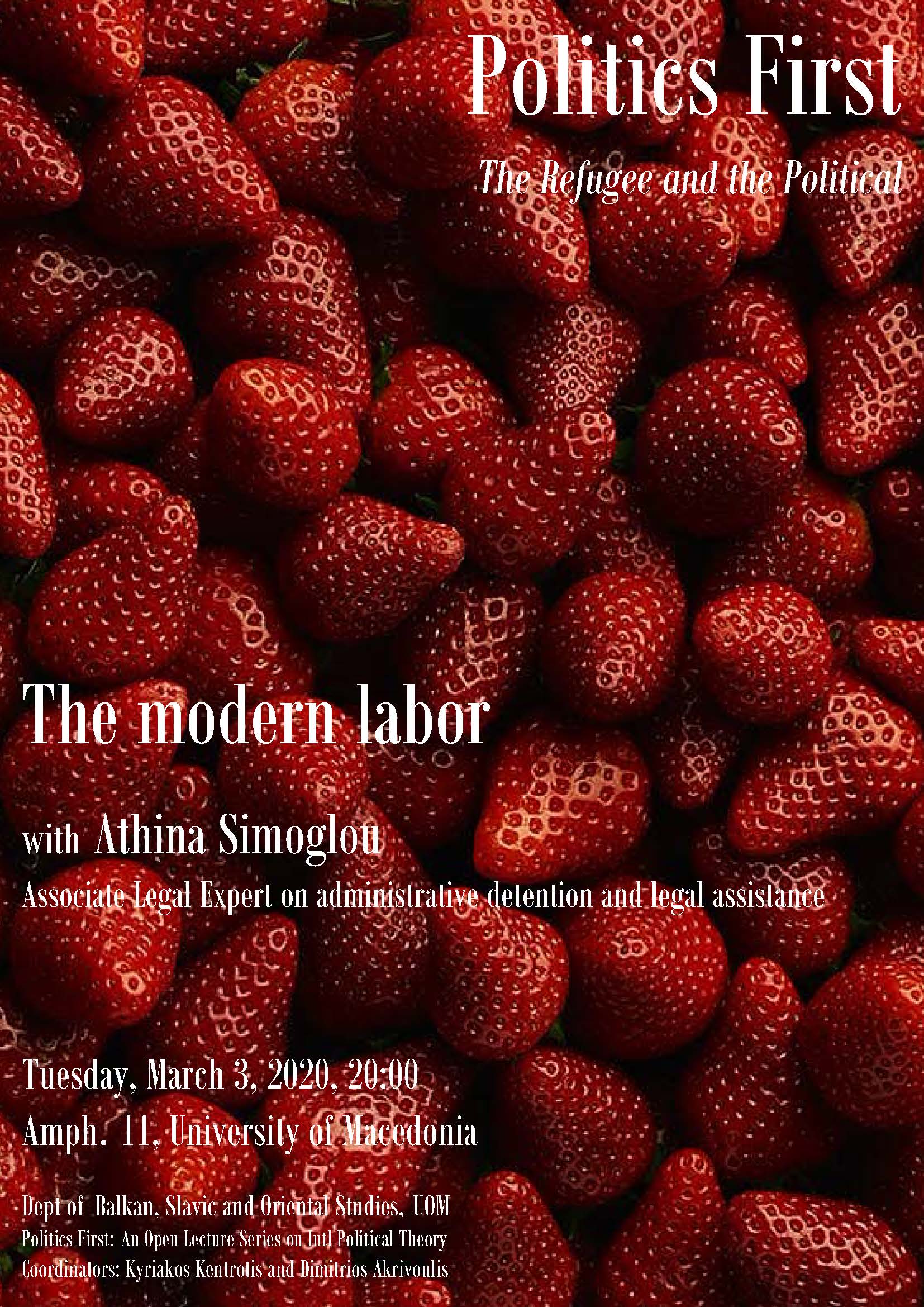
97th Politics First Open Lecture (The Refugee and the Political series) The Modern Labor With Athina Simoglou, Associate Legal Expert on administrative detention and legal assistance
Athina Simoglou is a lawyer. She has a master’s degree in public law and political science (AUTh) and in Social and Cultural Anthropology (Panteion University). Since 2011 she has been working in various projects of international organizations and NGOs in relation to asylum law and refugee status determination procedures in Greece. She currently works on administrative detention and legal assistance on asylum cases, in collaboration with UNHCR Office in Greece